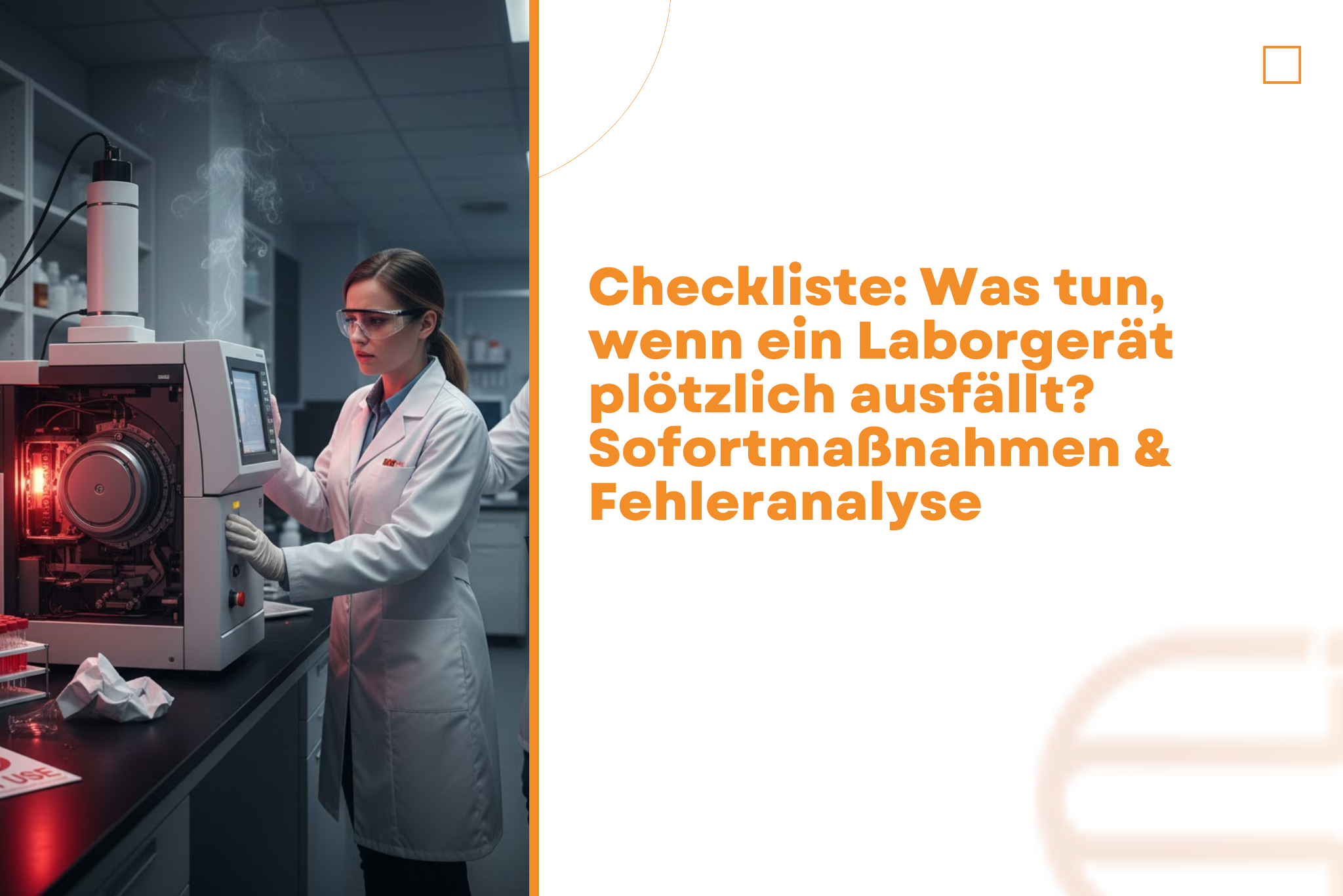
A sudden failure of laboratory equipment can disrupt workflows, compromise sample stability, and cause unnecessary downtime. In such situations, laboratories need a clear and reliable action plan. At Laborgeräte-Süd, we regularly support customers with unexpected equipment failures and understand how crucial immediate, well-structured measures are to prevent further damage. This checklist outlines the most important steps you should take immediately after an equipment failure to protect your processes and prepare for a precise fault analysis.
Safety is our top priority.
The first step in any equipment failure is safety. Voltage fluctuations, overheating, leaks, unusual noises, or unexpected shutdowns can indicate hazards requiring immediate attention. If the equipment appears unsafe, disconnect it from the power supply and evacuate the area. Employees should not touch any internal components until the situation has been fully assessed.
Stabilizing the work environment
Depending on the type of equipment, a failure can affect temperature-sensitive samples, ongoing experiments, or active processes. For example, if an incubator or refrigerator fails, samples must be transferred quickly. If analytical instruments fail during an ongoing measurement, partial results should be documented or connected processes should be stopped.
Document the device failure immediately.
Accurate and timely documentation is crucial. Record any visible problems, displayed error codes, unusual symptoms, and the conditions under which the failure occurred. This information is essential for technical support teams, service providers, and compliance audits.
Check power supply, connections and settings
Many device failures are caused by simple issues such as loose power cables, blown fuses, incorrect settings, or network interruptions. Checking these basic points can quickly resolve minor problems without causing further workflow disruption.
Check error messages and logs
Most modern laboratory instruments provide diagnostic messages or digital logs. Analyzing these messages can often reveal whether the problem is mechanical, electrical, software-related, or user-related. Logs also help identify patterns if similar errors have occurred previously.
Safely restart device
A controlled restart can reset internal systems and resolve temporary glitches. However, only restart devices if it is safe to do so and no active processes will be affected by a sudden shutdown.
User error vs. technical defect
A large proportion of equipment failures result from incorrect setup, incompatible accessories, miscalibration, or procedural errors. Distinguishing between user error and an actual technical defect is crucial for taking the correct corrective action. Technical defects often include worn components, sensor failures, motor malfunctions, or software errors.
Environmental and operational factors
Temperature fluctuations, vibrations, inadequate ventilation, dust accumulation, or unstable power supplies can contribute to unexpected malfunctions. Assessing external conditions is a crucial part of fault analysis – especially for precision instruments in regulated environments.
Calibration and qualification problems
Devices operated outside their calibration interval or lacking valid qualification (IQ/OQ/PQ) may produce inconsistent results. Missing or outdated calibration data can provide clues as to why the failure occurred and whether previous results might be affected.
Risk of consequential damage
If the device shows signs of overheating, a burnt smell, grinding noises, or mechanical resistance, troubleshooting should be stopped immediately. Continuing to operate a damaged device can lead to permanent damage or create safety hazards.
Unclear or repeated errors
If error messages reappear despite basic troubleshooting steps, or if diagnostics fail to identify a clear cause, a certified technician should be called in. Providing in-depth troubleshooting without the necessary expertise can jeopardize warranties or compromise regulatory compliance.
As a reliable supplier of laboratory equipment, Laborgeräte-Süd supports laboratories with comprehensive emergency assistance, maintenance, calibration, and equipment qualification. When laboratory equipment unexpectedly fails, fast and competent action is crucial to minimize downtime.
Laborgeräte-Süd offers:
Specialized on-site troubleshooting
Experienced technicians diagnose electrical, mechanical and performance-related defects directly on site – with minimal disruption to laboratory operations.
DAkkS-compliant calibration and requalification
If a failure indicates calibration drift or performance deviation, requalification (IQ/OQ/PQ) may be required. Laborgeräte-Süd ensures full compliance and complete documentation for audits.
Preventive maintenance programs
Unexpected breakdowns often result from inadequate maintenance. Preventive measures help to detect signs of wear and tear early, reduce future downtime, and protect sensitive workflows.
Comprehensive digital documentation
Every service call is digitally documented – for transparency, traceability and regulatory compliance across all laboratory equipment.
Lorem ipsum dModerne Labore verlassen sich auf strukturierte Wartungspläne, Umweltüberwachung, Mitarbeiterschulung und regelmäßige Kalibrierungen, um unerwartete Ausfälle zu vermeiden. Die Erstellung standardisierter Reaktionsverfahren stellt sicher, dass Teams genau wissen, was im Fehlerfall zu tun ist – und reduziert Risiken wie Datenverlust, Geräteschäden und Prozessunterbrechungen.olor sit amet, consectetur adipiscing elit. Ut elit tellus, luctus nec ullamcorper mattis, pulvinar dapibus leo.
Unexpected equipment failures are challenging, but with the right approach, their impact can be controlled. By acting quickly, providing clear documentation, and conducting targeted root cause analysis, laboratories can restore stability and prevent recurring downtime. At Laborgeräte-Süd, we support laboratories throughout the region with rapid on-site fault diagnosis, calibration, qualification, and preventative maintenance to ensure the reliable operation of all laboratory equipment. With a robust response strategy and our technical support, you can maintain continuity, protect data, and guarantee consistent performance across all workflows.
Sicherheit gewährleisten, Gerät ggf. vom Strom trennen, Umgebung stabilisieren und das Problem dokumentieren, bevor Sie mit der Fehlersuche beginnen.
Protokolle, Einstellungen und Abläufe prüfen. Falsche Parameter, Fehlbedienung oder inkompatibles Zubehör deuten häufig auf nutzerbedingte Fehler hin.
Bei mechanischen Geräuschen, elektrischem Geruch, wiederholten Fehlermeldungen oder unklaren Diagnosen ist professionelle Unterstützung erforderlich.
Regelmäßige Kalibrierung, vorbeugende Wartung, Umweltüberwachung und gute Mitarbeiterschulung reduzieren Ausfallrisiken erheblich.
Ja. Sie bieten Vor-Ort-Troubleshooting, Kalibrierung, Qualifikation und detaillierte Servicedokumentation, um Geräte schnell wieder funktionsfähig zu machen.